Last Updated on 21st July 2026 by peppe8o
When selecting a single-board computer (SBC) for 24/7 industrial deployments, edge computing, or critical IoT infrastructure, raw performance is only half the equation. The other – often decisive – half is reliability. How long can a board operate continuously before hardware failure occurs? How does vibration impact component lifespan?
Official reliability prediction metrics released by Raspberry Pi Ltd. (Document RP-003742-CF, found at https://pip.raspberrypi.com/categories/606-reliability) provided rare, precise insight into the operational lifespan of the entire Raspberry Pi ecosystem.
Key Takeaways at a Glance
- 43.2 → 10.7 Years: The stationary 24/7 lifespan drops from Pi 3B+ to Pi 5 due to increased component density and complex PMICs.
- 18x Lifespan Drop: Pi 5 lifespan falls from 10.7 years (stationary) to 0.6 years (~7.5 months) in mobile/vibrational environments.
- 1’055 Years: Theoretical MTTF silicon longevity of RP2040 microcontrollers.
The MIL-HDBK-217F-2 Methodology Explained
The calculations in the official document follow the MIL-HDBK-217F-2 Parts Count Reliability Prediction model, an established military standard developed by the U.S. Department of Defence.
Under the Parts Count method, the overall equipment failure rate () is calculated by summing the baseline statistical failure rates of all individual components (ICs, PMICs, capacitors, resistors, and connectors):
- (Quantity): How many parts of that specific type are on the board. If there are 200 capacitors, the risk for that part type is multiplied by 200.
- (Base Risk): The theoretical probability of a single part failing under ideal conditions.
- (Quality/Stress Factor): A “multiplier” for environmental stress. If the board is installed in a moving vehicle or exposed to high heat, this number goes up, accelerating wear and tear.
Because failure rates accumulate per component, more complex boards with higher component integration naturally yield lower predicted theoretical lifespans. The model evaluates two distinct operating environments:
- Ground Benign (GB): Controlled, stationary indoor environments (e.g., climate-controlled server rooms or sealed industrial cabinets) with negligible vibration and controlled ambient temperatures.
- Ground Mobile (GM): Uncontrolled mobile conditions (e.g., automotive, drones, or mobile robotics) subject to continuous mechanical vibration, physical shock, and thermal fluctuations.
Flagship SBCs: Lifespan Comparison in Years
Converting the raw MTBF metrics into continuous 24/7 operating years highlights the trade-off between compute density, power delivery complexity, and estimated physical lifespan.
| Product Name | Ground Benign (GB) (Stationary Lifespan) | Ground Mobile (GM) (Vehicle / Mobile Lifespan) |
| Raspberry Pi 3 Model B+ | 43.2 Years | 3.7 Years |
| Raspberry Pi 4 Model B | 24.1 Years | 3.1 Years |
| Raspberry Pi 5 | 10.7 Years | 0.6 Years (~7.5 mos) |
💡 Key Engineering Insight: While 10.7 years of continuous 24/7 operation in stationary conditions is excellent for a high-performance SBC, deploying a Raspberry Pi 5 in mobile environments without vibration isolation reduces its predicted lifespan to just 0.6 years (~7.5 months). This drop is probably driven by high component integration, sophisticated power management (PMIC), and clock crystal sensitivity.
Compute Modules: Industrial Lifespan Analysis
Compute Modules are engineered specifically for direct integration onto custom industrial carrier boards. By stripping away consumer-facing ports, they achieve higher operational reliability.
| Compute Module Variant | Ground Benign (GB) (Stationary Lifespan) | Ground Mobile (GM) (Vehicle Lifespan) |
|---|---|---|
| Raspberry Pi Compute Module | 199,8 Years | 36,5 Years |
| Raspberry Pi Compute Module 3 / 3+ | 199,8 Years | 36,5 Years |
| Raspberry Pi Compute Module 3 Lite / 3+ Lite | 222,6 Years | 40,0 Years |
| Raspberry Pi Compute Module 4 (No Radio Module) / (Including Radio Module) | 43,0 Years | 2,4 Years |
| Raspberry Pi Compute Module 4 IO Board | 45,1 Years | 2,5 Years |
| Raspberry Pi Compute Module 4 Lite | 43,6 Years | 2,4 Years |
| Raspberry Pi Compute Module 4S | 45,0 Years | 3,0 Years |
| Raspberry Pi Compute Module 5 | 16,3 Years | 1,8 Years |
| Raspberry Pi Compute Module 5 Lite | 19,2 Years | 1,8 Years |
| Raspberry Pi Compute Module 5 IO Board | 15,0 Years | 1,7 Years |
Comparing Predicted Lifetimes
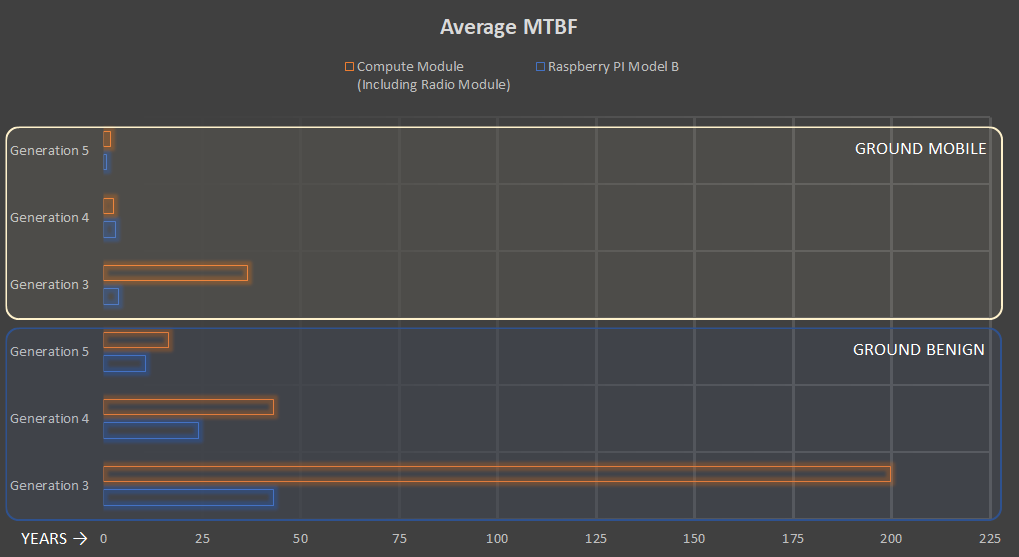
In the following chart, I compared the expected lifetime by putting together boards from the same generation. You can see there that Compute Modules are more reliable compared with their single-board computer versions. Moreover, you can also see the difference between Ground Benign and Ground Mobile values.
Hardware Breakdown: Component Vulnerability Hierarchy
Under MIL-HDBK-217F-2, individual component categories impact the failure rate differently. Understanding which parts are most vulnerable helps engineers optimise enclosure design:
| Hardware Component | Primary Function | Thermal Sensitivity | Vibration Sensitivity | Impact on Overall MTBF |
| Quartz Crystals / Oscillators | System clock generation | Medium | Extreme 🚨 | Dominates GM (Mobile) failure rates |
| PMIC / Power Regulators | Voltage regulation & distribution | Extreme 🚨 | Medium | Dominates GB (Stationary) failure rates |
| I/O Connectors (USB, RJ45) | Physical interfacing | Low | High ⚠️ | High in consumer SBCs; eliminated in CMs |
| Multilayer Capacitors (MLCCs) | Filtering & power smoothing | Medium | Low | Cumulative penalty (high quantity count) |
| Main SoC (Broadcom) | Processing core | High (BGA joints) | Medium | Moderate (Silicon MTTF itself is extremely high) |
Microcontrollers & Custom Silicon Longevity
At the raw silicon component level (Mean Time To Failure – MTTF), Raspberry Pi’s custom ICs – the RP2040 and RP235x – demonstrate practically indefinite silicon longevity when operating at continuous junction temperatures:
- RP2040 / RP235x Silicon (60% Confidence Level): 1,055.9 Years
- RP2040 / RP235x Silicon (95% Confidence Level): 450.1 Years
Finally, the following values give us the Raspberry Pi microcontrollers (Pico) expected lifetime:
- Raspberry Pi Pico W / Pico 2 W Board (Stationary): 20.9 Years (1.3 Years Mobile)
- Raspberry Pi PoE+ HAT (Stationary): 25.1 Years (1.5 Years Mobile)
Methodological Limits & Actionable Checklist
⚠️ Important Disclaimer: MIL-HDBK-217F-2 is a theoretical, hardware-only model. It assumes constant failure rates over time and does not account for flash storage write exhaustion (MicroSD card corruption) or software crash loops. In real-world deployments, MicroSD cards almost always fail long before the Raspberry Pi’s silicon or solder joints.
📋 Actionable Guidelines to Maximise Real-World MTBF
- Isolate Mechanical Stress: Use anti-vibration rubber mounts (silentblocks) in mobile/automotive applications to bridge the gap between Mobile (GM) and Stationary (GB) lifespans.
- Keep Junction Temperatures Low: Heat accelerates thermal degradation on PMICs and BGA solder balls. Active cooling on Pi significantly extends operational life.
- Eliminate Consumer Ports: Choose Compute Modules (CM4/CM5) for high-vibration environments to eliminate delicate USB/Ethernet spring contacts.
- Replace MicroSD with Industrial Storage: Always use industrial eMMC flash or NVMe SSDs to match the long physical hardware lifespan.
- For Makers or home DIY: Raspberry Pi 3 or Raspberry Pi 4 offer 4x and 2x average lifetime compared to Raspberry PI 5. If you don’t have specific needs for computing power, I suggest reducing the costs and getting a board with higher life expectancy.
Next Steps
Interested in more projects with your Raspberry PI? Try to look at my Raspberry PI computer tutorial pages.
Enjoy!
Open source and Raspberry PI lover, writes tutorials for beginners since 2019. He's an ICT expert, with a strong experience in supporting medium to big companies and public administrations to manage their ICT infrastructures. He's supporting the Italian public administration in digital transformation projects.